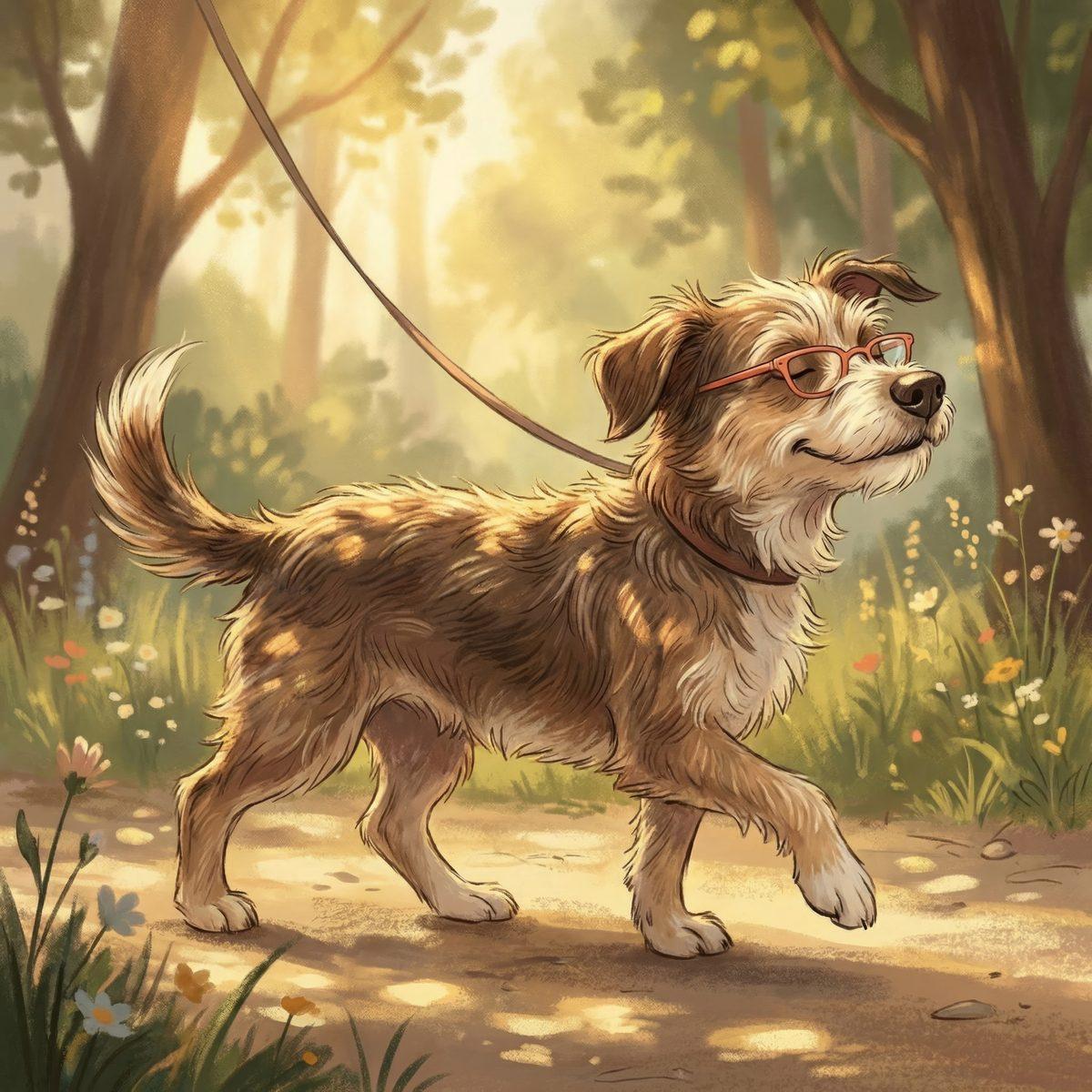
Your dog is a better self-help teacher than any bestselling author, wellness app, or $200 workshop. Dogs naturally practice five skills the mindfulness industry charges you for: finding joy in ordinary moments, forgiving instantly, greeting people with full-body enthusiasm, eating without guilt, and using their bodies without judging them. My Dog Is Better at This Than Me by B.K. Larrikin explores 10 of these lessons through the story of a rescue dog named Rosie — and includes practical exercises you can do without downloading anything or sitting cross-legged.
Your dog is the best self-help guru you'll never have to pay — a being who practices presence, acceptance, resilience, joy, and connection instinctively, without a subscription, a certification, or a branded meditation cushion.
I have read, conservatively, about forty self-help books. I've listened to the podcasts. I've done the journaling prompts. I've sat in workshops where a very calm person in linen told me to “find my inner compass” while I tried not to think about lunch. And after all of that—after all those hours and all those highlighted passages—the single most transformative influence on my daily happiness has been a creature who drinks out of the toilet.
My dog. My ridiculous, beautiful, endlessly optimistic dog. Who has never read a book in their life but somehow embodies every principle those books were trying to teach me.
A meta-analysis published in PLOS One found that a single session of genuine laughter reduces cortisol levels by approximately 37%. Your dog generates this every time she misjudges a frisbee catch. The human-dog bond activates the same oxytocin feedback loop as the bond between mothers and infants — a hormonal connection science spent decades confirming and your dog knew the moment you walked through the door. Scientific American reports that adults who maintain active play lives are measurably happier and more resilient. The self-help industrial complex charges for this. Your dog offers it for free, daily, with an enthusiasm that borders on medical emergency.
What Can Dogs Teach Us About Happiness?
Here is what the self-help industry does: it takes something simple, wraps it in jargon, adds a seven-step framework, slaps a TED Talk on it, and sells it back to you for $24.99 (hardcover, $14.99 Kindle). And what is that simple thing, usually? Something your dog has been doing since the day you brought them home.
“Live in the present moment.” Your dog has literally never lived anywhere else. “Practice radical acceptance.” Your dog accepts you coming home in sweatpants at 2pm on a Tuesday with the same enthusiasm as if you'd returned from war. “Find joy in the ordinary.” Your dog just spent eleven minutes being happy about a stick. Not a special stick. Just a stick.
Lesson One: Lower Your Standards for Happiness
This sounds like terrible advice until you realize what it actually means. Humans have become happiness perfectionists. We've set the bar so high that only major life events clear it—promotions, vacations, milestones. Everything else is just... getting through the day.
Dogs have the happiness bar set at roughly ankle height, and they are better for it. A walk? Ecstatic. Dinner? The best thing that has ever happened. You came home? This is literally the greatest day of their life (again). They don't need extraordinary circumstances to feel extraordinary joy.
You don't need to lower your ambitions. Lower your threshold for what counts as a good moment. More things become worth celebrating when you stop requiring them to be extraordinary.
Marc Bekoff, professor emeritus at the University of Colorado and author of The Emotional Lives of Animals, writes: “Emotions are the gifts of our ancestors. We have them and so do other animals. We must never forget this.”
Why Is My Dog Better at Forgiveness Than I Am?
You stepped on your dog's paw. You felt terrible. Your dog yelped, looked confused for approximately 1.5 seconds, and then came back for more pets. Forgiveness completed. No processing period. No silent treatment. No bringing it up three weeks later during an unrelated argument.
Humans hold onto grievances like collectors hold onto rare stamps—carefully, categorically, and with no intention of ever letting them go. We build mental filing cabinets of wrongs done to us, organized by date and severity, and we consult them regularly.
Dogs don't have filing cabinets. Dogs have the emotional storage capacity of a goldfish with the heart of a saint. Something happens, they feel it, and then they move on. Not because they're unintelligent. Because they're wise enough to know that carrying it doesn't help.
Lesson Three: Be Enthusiastic About Your People
When was the last time you greeted someone the way your dog greets you? Full body, uncontainable, zero-percent-cool enthusiasm? Probably never. Because somewhere along the way, we decided that being visibly excited to see someone was embarrassing.
Your dog never got that memo. Your dog greets you like a celebrity walking onto a talk show stage every single time you come through that door. And you know what? It makes you feel incredible. Because being openly, unapologetically valued is one of the best feelings a human can experience.
“What if we treated the people we love the way our dogs treat us when we walk through the door?”
Lesson Four: Don't Overthink Lunch
Your dog does not stand in front of the pantry for seven minutes experiencing a low-grade existential crisis about what to eat. Your dog does not feel guilty about carbs. Your dog does not count macros or wonder if they should have had the salad.
Food appears. Food is eaten. Joy is experienced. That's it. The entire emotional journey of a dog's meal is: anticipation, delight, satisfaction, nap. Meanwhile, we have turned eating into a psychological obstacle course complete with guilt hurdles and shame water traps.
Lesson Five: Your Body Is for Using, Not Judging
Dogs run because running feels good. They stretch because stretching feels good. They roll in grass because—well, we're not entirely sure why, but they seem to enjoy it immensely. At no point does a dog look at their reflection and think, “I should probably do more cardio.”
Dogs relate to their bodies as instruments of joy, not objects of scrutiny. They use their bodies to experience the world—to smell, to run, to cuddle, to play. The body is a vehicle for living, not a project to be fixed.
The Bottom Line
Your dog is not trying to be a guru. That's what makes them so good at it. They are simply living in a way that prioritizes connection, joy, presence, and rest. They're not following a system. They don't have a personal brand. They are just being a dog, and that turns out to be the best self-help program on the market.
The next time you reach for another self-help book, look down first. Your guru is probably napping at your feet. If you want the full curriculum, read Chapter 1 free or see what all 10 lessons look like. And if you want the science behind why this works, start with 5 Mindfulness Lessons Dogs Teach Every Day.
Frequently Asked Questions
What are the best self-help books that are actually funny?
My Dog Is Better at This Than Me by B.K. Larrikin tops the list for 2026 — it's a humor-first self-help book where a rescue dog named Rosie teaches 10 mindfulness lessons. Other standouts include Furiously Happy by Jenny Lawson, The Subtle Art of Not Giving a F*ck by Mark Manson, Hyperbole and a Half by Allie Brosh, and Is Everyone Hanging Out Without Me? by Mindy Kaling.
Can dogs actually teach mindfulness?
Dogs naturally practice presence, acceptance, play, and rest — the core skills that mindfulness training aims to develop. Research on human-animal interaction shows that spending time with dogs can reduce cortisol and increase oxytocin. My Dog Is Better at This Than Me builds practical exercises around these observations, no meditation cushion required.
What is an anti-self-help book?
An anti-self-help book delivers genuine wellness advice while poking fun at the self-help industry's excesses — the $79 apps, the silent retreats, the branded meditation cushions. My Dog Is Better at This Than Me is the anti-self-help book for dog lovers: it argues that a sixty-pound rescue dog has more to teach you about living well than a decade of optimized morning routines.
What self-help books are good for people who don't like self-help?
If traditional self-help feels preachy, look for books that lead with humor and story. My Dog Is Better at This Than Me by B.K. Larrikin uses dog anecdotes and self-deprecating honesty instead of prescriptive advice. The mindfulness exercises are practical and short — three minutes, no equipment, dignity optional.
Want the full philosophy? Join the Pack for weekly dog wisdom and the free Cheat Sheet — all 10 life lessons on one page.
Join the Pack